

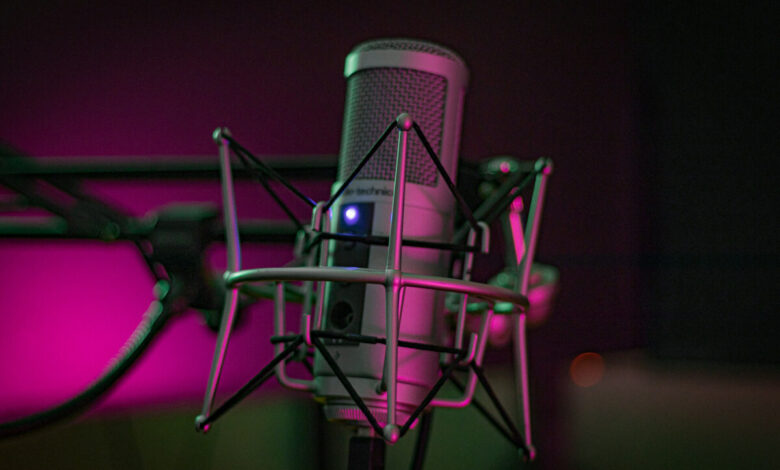
In an untreated, echoey room, a cardioid dynamic mic worked close to your mouth is the safer starting point. Its lower sensitivity pushes you to work close, and closeness is what keeps your voice loud relative to the room. But the mic type is not the real variable. The ratio of direct voice to reflected room sound at the capsule is, and a condenser used just as close narrows the gap.
Most advice stops at “buy a dynamic.” That is a reasonable default, but knowing why it works tells you what to do with the mic you already own, and when a condenser is still the better choice for a room you cannot change.
Why dynamic mics get recommended for echoey rooms
The core difference between the two types is sensitivity. Microphone maker LEWITT puts it plainly in its dynamic vs condenser guide: “The most relevant difference between condenser and dynamic microphones is sensitivity.” Condensers have higher sensitivity and suit sources “that need to be reproduced in great detail or are further away,” while dynamics have low sensitivity and “require higher gain on your preamp.”
In a bare room, that higher sensitivity means a condenser at a comfortable distance picks up a lot of reflected sound: your voice bouncing off the walls, the desk, the ceiling and the window, arriving a fraction of a second late. That smear is what makes a recording sound like a bathroom. A dynamic at the same distance picks up less of everything, so people naturally move closer to get a usable level, and the room drops away as they do.
The part the “just buy a dynamic” advice leaves out
The same LEWITT guide carries a line most roundups skip: “a dynamic microphone is not better in isolating your voice or works ‘better’ in an untreated room. The main difference between the two microphones is, as stated before, the difference in sensitivity and high-frequency accuracy.”
That is worth taking seriously, because it points at the real mechanism. What the room contributes depends on how loud your voice is at the capsule compared with the reflections reaching it. Your direct voice gets much louder as the mic moves closer. The reflected sound in a room stays roughly the same wherever the mic sits. So distance, not the type of diaphragm, sets the ratio.
A dynamic mic mostly wins in untreated rooms because it forces a close working distance. Put a dynamic at arm’s length and it will sound roomy too. Put a condenser a few inches from your mouth and much of the room falls away.
Condenser vs dynamic mic in an untreated room, side by side
| Dynamic | Condenser | |
|---|---|---|
| Sensitivity | Low | High |
| Gain it needs | More | Less |
| Power | None | Phantom power on XLR, or USB power |
| Natural working distance | Close | Can work farther away |
| What it hears in a bare room | Less room at a close distance | More room at the same distance |
| If you drift away from it | Level drops quickly | Level holds better, but the room rises |
| High-frequency detail | Less | More, per LEWITT |
Phantom power is the supply condenser mics draw over the XLR cable. The Wikipedia entry on the XLR connector, notes that condenser microphones “require power” and that phantom power is the usual alternative to batteries. USB condensers take their power from the USB port instead.
When a condenser is still the better pick in a bad room
The dynamic default has real costs, and in some setups they outweigh the benefit.
Your preamp is weak. Because dynamics need more gain, a basic interface or a simple adapter may run out of clean gain before your voice is loud enough. The result is a quiet recording that hisses when you raise it later. A condenser worked close needs less gain and can come out cleaner.
You cannot stay in one spot. If you move while you talk, a dynamic’s level drops sharply every time you lean back. A condenser tolerates movement better, as long as you accept a little more room in the sound.
You want more detail and the room is small but furnished. A bedroom full of soft furniture reflects less than an empty office. In that kind of room, a condenser at a close distance can capture more detail without bringing in much of the room.
None of these are reasons to put a condenser across the desk from you. Close distance is still the rule for both types.
The pickup pattern matters as much as the type
Most podcast and voice mics of both types are cardioid, which hears best from the front and least from directly behind. LEWITT’s polar pattern guide, gives a typical cardioid’s rear rejection as about 20 dB, meaning sound from behind is picked up at roughly a tenth of the front sensitivity.
That makes placement a free fix. Point the back of the mic toward the loudest reflective surface or the noisiest part of the room, and keep the front aimed at your mouth. Watch your own headphones as well. Open headphones spill sound that a sensitive condenser will catch, which is one reason closed-back headphones are the standard choice while recording.
Echo and noise are different problems
Before choosing a mic, make sure the problem is the room at all. Echo is your own voice coming back from hard surfaces. Background noise is some other sound in the space: a fan, traffic, a fridge. They call for different fixes, in the same way that ANC and noise isolation solve different kinds of noise for headphones.
A dynamic worked close helps with both, which is part of its reputation. But if your issue is a steady hum, lowering gain and moving closer does more than changing mic type. If your issue is echo, adding soft surfaces around the mic and working closer does more than either.
A ten-minute test with the mic you already own
You do not need to buy anything to find out how much the room is costing you.
- Record the same two sentences at three distances: roughly a hand’s width, twice that, and arm’s length.
- Adjust the gain each time so your voice peaks at a similar level on the meter.
- Listen back on closed headphones, paying attention to the tail after each sentence ends.
If the tail is barely there at the closest distance and obvious at arm’s length, distance is your fix, and the mic type matters less than you thought. If the room is still clearly audible at the closest position, the room itself needs soft surfaces, and a dynamic will help a little more than a condenser would.
Where headsets fit
A headset boom mic sits close to your mouth by design and stays there when you move, which is why headset calls often sound drier than a desk mic in the same room. That is the distance principle again, built into the hardware. If you are weighing that route instead, the difference between a gaming headset and separate headphones and a mic covers the trade-offs.
FAQ
Is a dynamic mic always better in an untreated room?
No. It is the safer default because it encourages close work, but LEWITT states that a dynamic is not inherently better at isolating your voice. Distance and pickup pattern decide how much of the room you capture.
Why does my condenser mic sound echoey?
Its high sensitivity picks up reflected sound at a normal speaking distance. Move closer, lower the gain to match, and point the back of the mic at the most reflective surface.
Do dynamic mics need a special preamp?
Not a special one, but they need more gain than condensers. If your interface runs out of gain before your voice is loud enough, the recording will be quiet, or noisy once raised.
Should I treat the room or change the mic first?
Change your distance first, since it costs nothing. Then add soft surfaces around the recording spot. Change the mic last.
The short version
In an untreated room, work close, whatever mic you own. A cardioid dynamic makes close work the default, which is why it is the forgiving choice. A condenser can do the job too if you keep it close and point its back at the room. The mic type is the smaller decision; distance is the bigger one.


