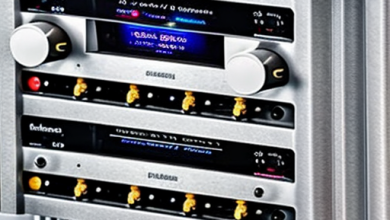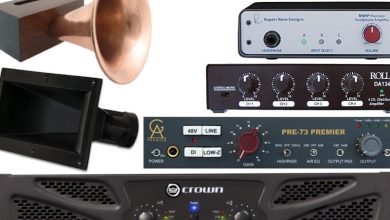
An amplifier is an electronic device that increases the voltage, current, or power of a signal. Amplifiers can be found in a wide range of electronic devices, including radios, televisions, and music systems. They are also used in musical instruments, such as electric guitars, to produce a louder sound.
Amplifiers work by taking a small electrical signal and boosting it to a higher level. The signal is fed into the amplifier through an input, and the amplifier then processes the signal to increase its power. The amplified signal is then output through a speaker or other device. There are many different types of amplifiers, including vacuum tube amplifiers, solid-state amplifiers, and hybrid amplifiers. Each type of amplifier has its own unique characteristics and advantages, and the choice of amplifier depends on the specific application and the preferences of the user.
Understanding Amplifiers
An amplifier is an electronic device that increases the amplitude of a signal. Amplifiers are used extensively in audio systems, where they are used to increase the volume of music or other audio signals. Amplifiers are also used in other types of electronic systems, such as radio and television transmitters, to increase the power of the signal being transmitted.
Amplifiers work by taking a small input signal and increasing its amplitude to produce a larger output signal. The amount of amplification provided by an amplifier is called the gain, which is usually measured in decibels (dB). The gain of an amplifier is determined by the ratio of the output signal amplitude to the input signal amplitude.
One of the most common uses of amplifiers is to increase the volume of music or other audio signals. In audio systems, the volume control adjusts the level of the input signal that is sent to the amplifier. The amplifier then increases the amplitude of the signal to produce a louder output signal. The volume control and the amplifier gain work together to produce the desired volume level.
Amplifiers are also used to boost weak signals, such as those received by an antenna or microphone. The amplifier increases the amplitude of the signal, making it stronger and easier to process. In radio and television systems, amplifiers are used to boost the signal before it is transmitted to improve the signal quality and range.
amplifiers are electronic devices that increase the amplitude of a signal. They are used to increase the volume of music and other audio signals, boost weak signals, and improve the quality and range of radio and television transmissions. The gain of an amplifier is a measure of the amount of amplification provided, and is usually measured in decibels.
Components of an Amplifier
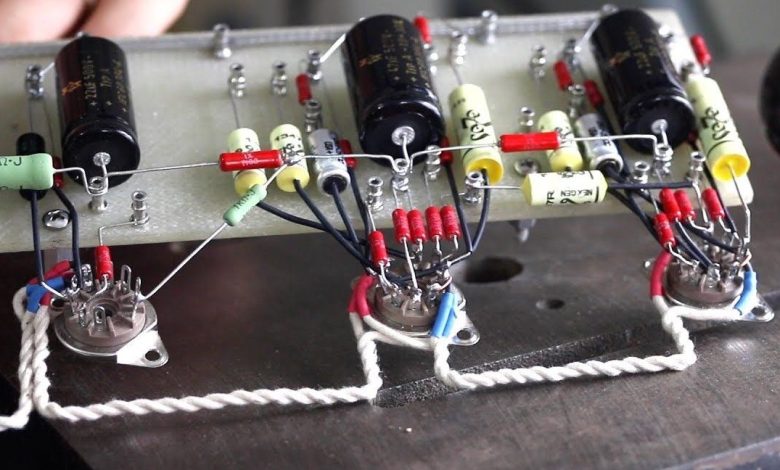
An amplifier is an electronic device that increases the power of a signal. It consists of various components that work together to amplify the input signal. The primary components of an amplifier are the power supply, transistors, capacitors, resistors, and transformers.
Power Supply
The power supply is the first component of an amplifier. It provides the necessary power to the amplifier to function. The power supply converts the AC voltage from the wall outlet to the DC voltage required by the amplifier. The power supply can be a simple transformer or a more complex circuit that includes rectifiers and filters.
Transistors
Transistors are the most important components of an amplifier. They are responsible for amplifying the input signal. Transistors are semiconductor devices that can switch and amplify electronic signals. There are two types of transistors used in amplifiers: bipolar junction transistors (BJTs) and field-effect transistors (FETs). BJTs are used in low-power amplifiers, while FETs are used in high-power amplifiers.
Capacitors
Capacitors are used in amplifiers to store and discharge electrical energy. They are used to block DC voltage and allow AC voltage to pass through. Capacitors are also used to filter out unwanted noise and improve the signal-to-noise ratio of the amplifier.
Resistors
Resistors are used in amplifiers to control the flow of current and voltage. They are used to bias the transistors and set the gain of the amplifier. Resistors are also used to limit the current and voltage in the amplifier.
Transformers
Transformers are used in amplifiers to step up or step down the voltage of the input signal. They are used to isolate the input and output signals and prevent ground loops. Transformers are also used to match the impedance of the input and output signals.
an amplifier consists of various components that work together to amplify the input signal. The power supply provides the necessary power, transistors amplify the signal, capacitors filter out unwanted noise, resistors control the flow of current and voltage, and transformers match the impedance of the input and output signals.
How Amplifiers Work
Amplifiers are electronic devices that increase the amplitude of an input signal to produce a larger output signal, making it stronger and more powerful. Amplifiers are used in a wide range of applications, from audio systems to industrial control systems.
Amplification Process
The amplification process in an amplifier involves taking a weak input signal and increasing its amplitude to produce a stronger output signal. This process is achieved using a variety of electronic components, including transistors, diodes, and operational amplifiers.
Transistors are commonly used in amplifiers to control the flow of current through a circuit. They can be configured in a number of ways, such as common emitter, common collector, or common base, to provide different levels of amplification.
Diodes are also used in amplifiers to provide signal rectification and voltage regulation. They can be used to create a simple amplifier circuit, such as a voltage follower or a non-inverting amplifier.
Operational amplifiers, or op-amps, are high-gain amplifiers that are commonly used in audio and instrumentation applications. They are designed to provide a high degree of amplification and can be configured in a variety of ways to provide different levels of gain and feedback.
Signal Processing
Signal processing is an important part of the amplifier circuit, as it involves filtering and shaping the input signal to produce a clean and accurate output signal. This process is achieved using a variety of electronic components, including capacitors, resistors, and inductors.
Capacitors are used in amplifiers to block DC signals and allow AC signals to pass through. They can also be used to filter out unwanted noise and interference from the input signal.
Resistors are used in amplifiers to provide biasing and feedback. They can be used to set the gain of the amplifier circuit and provide negative feedback to improve stability and reduce distortion.
Inductors are used in amplifiers to provide filtering and frequency response. They can be used to block high-frequency signals and allow low-frequency signals to pass through, or vice versa.
Output Generation
The output generation process in an amplifier involves converting the amplified signal into a usable form, such as a voltage or current. This process is achieved using a variety of electronic components, including transformers, transistors, and power amplifiers.
Transformers are commonly used in audio amplifiers to match the impedance of the amplifier to the load, such as a speaker. They can also be used to provide isolation and reduce noise and interference.
Transistors are used in power amplifiers to provide high levels of current and voltage. They can be configured in a number of ways, such as class A, class B, or class AB, to provide different levels of efficiency and distortion.
Power amplifiers are used to provide high levels of power to drive large loads, such as speakers or motors. They can be configured in a variety of ways, such as push-pull or bridge, to provide different levels of power and efficiency.
amplifiers are essential components in electronic circuits that provide amplification, signal processing, and output generation. They are used in a wide range of applications and can be configured in a variety of ways to provide different levels of gain, feedback, and efficiency.
Types of Amplifiers
There are three main types of amplifiers: tube amps, solid state amps, and hybrid amps. Each type has its own unique characteristics and advantages.
Tube Amps
Tube amps, also known as valve amps, use vacuum tubes to amplify the signal. These amps are known for their warm, rich sound and are often associated with classic rock and blues. Electric guitar legends like Jimi Hendrix used tube amps extensively, and iconic amp brands like Fender, Marshall, and Vox are known for their tube amps.
Tube amps can be classified into different categories based on their design and output. Class A amps use a single tube to amplify the signal and produce a pure, clean tone. Class AB amps use two tubes to amplify the signal and are more efficient than Class A amps. EL84 is a popular type of tube used in many guitar amps.
Solid State Amps
Solid state amps use transistors and other solid-state components to amplify the signal. These amps are known for their reliability and durability, and are often used in modern music genres like metal and punk. Solid state amps are also more affordable than tube amps.
Solid state amps can be classified into different categories based on their design and output. Class A amps use a single transistor to amplify the signal and produce a warm, natural tone. Class AB amps use two transistors to amplify the signal and are more efficient than Class A amps.
Hybrid Amps
Hybrid amps combine the best of both worlds by using both tubes and solid-state components to amplify the signal. These amps are known for their versatility and can produce a wide range of tones. Hybrid amps are also more affordable than pure tube amps.
Hybrid amps can be classified into different categories based on their design and output. Some hybrid amps use a tube preamp and a solid-state power amp, while others use a solid-state preamp and a tube power amp.
Understanding Amps
An amp, short for ampere, is the unit of measurement for electrical current flow in a circuit. It is named after the French mathematician and physicist André-Marie Ampère. The symbol for ampere is “A”. Electrical current is the flow of electric charge through a conductor, usually measured in amperes.
Amps are essential in determining the power of an electrical system. The amount of power in a circuit is determined by the voltage and current. The voltage is the electrical force that pushes the current through the circuit. The unit of measurement for voltage is volts (V). The current is the flow of electrical charge in the circuit, measured in amperes (A). The power in the circuit is measured in watts (W), which is the product of voltage and current.
In simple terms, the more amps that flow through a circuit, the more power is produced. However, it is important to note that the amount of power produced also depends on the load, or the resistance of the circuit. A high load will reduce the amount of current that flows through the circuit, resulting in less power produced.
When working with electrical systems, it is important to be aware of the amp rating of the components being used. Electrical devices, such as speakers or amplifiers, have specific amp ratings that determine the maximum amount of current they can handle. Exceeding the amp rating can cause damage to the device or even start a fire.
amps are a crucial unit of measurement in electrical systems, determining the flow of electrical current and the amount of power produced. It is important to be aware of the amp rating of electrical components to ensure safe and efficient operation.
The Role of Amp in Electrical Systems
Amplifiers, commonly known as amps, play a crucial role in electrical systems. They are used to increase the power of an electrical signal, making it stronger and more capable of driving other components in the system. Amps are used in a wide range of electronic devices, from audio equipment to televisions and computers, and radios.
In Audio Equipment
In audio equipment, amps are used to amplify the audio signal produced by the player. The audio signal is transmitted through wires to the amp, which then amplifies the signal and sends it to the loudspeaker. The loudspeaker converts the electrical signal into sound waves that can be heard by the listener.
In Televisions and Computers
Amps are also used in televisions and computers to amplify the video signal. The video signal is transmitted through wires to the amp, which then amplifies the signal and sends it to the display. The display converts the electrical signal into a visual image that can be seen by the viewer.
In Radios
In radios, amps are used to amplify the radio signal received by the antenna. The radio signal is transmitted through wires to the amp, which then amplifies the signal and sends it to the loudspeaker. The loudspeaker converts the electrical signal into sound waves that can be heard by the listener.
amps play a crucial role in electrical systems by amplifying electrical signals produced by various components such as players, wires, and grids. They are used in a wide range of electronic devices such as speakers, televisions, computers, and radios to amplify audio and video signals and make them more powerful.
AMP Pages and Web Development
What are AMP Pages
AMP (Accelerated Mobile Pages) is an open-source project that aims to improve the performance of web pages on mobile devices. AMP pages are essentially a stripped-down version of regular HTML pages, designed to load quickly and efficiently on mobile devices.
AMP pages are built using a combination of HTML, CSS, and JavaScript, with some restrictions on the use of certain types of scripts, fonts, and other resources that can slow down page loading times.
How AMP Pages Work
AMP pages work by using a number of optimizations to reduce page loading times and improve performance. Some of these optimizations include:
-
Asynchronous Loading: All AMP JavaScript is executed asynchronously, which means that it does not block the rendering of the page. This allows the page to load quickly and smoothly, even on slower mobile devices.
-
Lazy Loading: Images and other resources are loaded only when they are needed, which helps to reduce page loading times and improve performance.
-
Caching: AMP pages are designed to be cached by third-party servers, which can help to improve page loading times and reduce server load.
-
Preconnect and Prefetch: AMP pages use preconnect and prefetch to speed up the loading of resources by establishing connections with servers before they are needed.
Advantages of AMP Pages
There are several advantages to using AMP pages for web development, including:
-
Improved Page Loading Times: AMP pages are designed to load quickly and efficiently on mobile devices, which can help to improve user experience and reduce bounce rates.
-
Better SEO: Google has stated that AMP pages may receive preferential treatment in search results, which can help to improve visibility and drive more traffic to your site.
-
Reduced Development Time: Because AMP pages are designed to be easy to build, they can reduce the need for extensive developer resources and quickly convert an archive of content.
-
Cross-Platform Support: Multiple platforms support AMP, including Google, Bing, and Twitter, which makes it easier to reach a wider audience and improve your web strategy.
AMP pages are a powerful tool for web development that can help to improve page loading times, SEO, and user experience. By using a combination of HTML, CSS, and JavaScript, along with a number of optimizations, AMP pages can deliver fast, efficient, and engaging experiences on mobile devices.
Conclusion
Accelerated Mobile Pages (AMP) is a technology that helps to improve the speed and performance of mobile web pages. It is designed to deliver content almost immediately by stripping pages down to their most essential parts and storing a cached version on Google servers. This allows users to access web pages faster and with less data consumption.
AMP is a powerful tool that can help businesses and website owners to improve their mobile web presence. By implementing AMP, website owners can improve their website’s performance, increase user engagement, and improve search engine rankings. However, it is important to note that AMP is not a silver bullet solution and should be used in conjunction with other optimization techniques.
AMP is a valuable technology that can help website owners to improve their mobile web presence and provide a better user experience. By implementing AMP, website owners can ensure that their mobile web pages are fast, responsive, and easy to use.