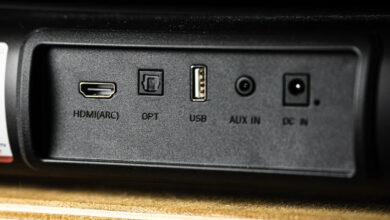
An AV receiver with real speakers will out-perform a soundbar at the same spend, but that advantage only exists if your room lets you place and wire the speakers properly. If you cannot run cable to two rear positions, cannot seat people in roughly the middle of the room, or cannot put boxes on stands either side of the screen, most of what you are paying a receiver for never arrives. In that case a soundbar is not the compromise, it is the correct answer. Decide by your room first and by sound quality second, because the room is what makes the sound quality possible.
That reverses the order almost every comparison uses, and it is the order that produces fewer regrets.
The four gates
Answer these before you compare a single product. Each one is a physical fact about your home, not a preference.
Gate 1: can you get speaker cable to two rear positions?
Surround speakers need to be behind or beside the seating, and passive speakers need wire from the receiver to each one. That means running cable under carpet, along baseboards, through a wall, or accepting it taped down the side of the room. Wireless surround kits exist for some receiver platforms, but they still need mains power at each rear speaker, which is the constraint people forget. If the answer is no, a receiver's surround advantage is theoretical.
Gate 2: is your seating roughly in the middle of the room?
Surround imaging assumes the listener sits somewhere near the middle of the speaker array. A sofa pushed flat against the back wall puts your ears within inches of a boundary, which does bad things to bass and puts the rear speakers effectively on top of you. A soundbar, which throws everything from the front, cares much less about this.
Gate 3: can you place a subwoofer somewhere other than jammed in a corner?
Corner placement is convenient and it does make bass louder, because it excites the room's modes most strongly. It also tends to make bass boomier and less even from seat to seat. If the only available spot is a corner behind furniture, you will get less from a good subwoofer than the spec sheet suggests. This site covers the placement question in more detail in where to put a subwoofer.
Gate 4: will everyone who lives there accept the boxes?
This is not a joke gate. Five speakers, a subwoofer, stands and visible cable is a substantial change to a shared living room, and a receiver system that gets dismantled after a month was the wrong purchase regardless of how it measured.
If you failed two or more gates, stop comparing and buy a soundbar. If you passed all four, a receiver is genuinely open to you and the rest of this article is about what you actually gain.
What a receiver gives you that a bar cannot
| Soundbar | AV receiver and speakers | |
|---|---|---|
| Surround from real positions | Simulated from the front, room-dependent | Actual speakers at actual angles |
| Upgrade path | Replace the whole unit | Swap one speaker at a time, keep the rest |
| Speaker choice | Fixed, whatever the maker built in | Any passive speakers you like |
| Video switching | Usually none, the TV switches | Receiver switches sources and passes video |
| Setup effort | An hour, one cable | An afternoon, calibration, placement |
| Room tolerance | Forgiving | Rewards a good room, punishes a bad one |
| Footprint | Under the TV | A rack plus five or more speaker positions |
The upgrade path is the underrated column. With a receiver you can start with a front three and a subwoofer and add rears later, or replace the front pair in three years and keep everything else. A soundbar is a single product with a single lifespan.
The ceiling nobody mentions: your TV's audio return path
Here is the structural difference that most comparisons skip entirely, and it changes the decision for some people.
With a receiver, the receiver is usually the hub. Sources plug into it, it decodes the audio and passes the video on to the TV. The audio never has to travel backwards through the TV at all, so it is not limited by what the TV's return path can carry.
With a soundbar, the usual arrangement is the reverse. Sources plug into the TV, and the TV sends audio back down to the bar over the HDMI audio return channel. That means the bar's ceiling is set by the TV's return path, not by the bar. Standard ARC carries compressed surround, including the lossy version of object audio delivered inside Dolby Digital Plus. The enhanced version, eARC, has the bandwidth for the lossless formats such as Dolby TrueHD and DTS:X. So a very capable soundbar connected to a TV with only standard ARC is capped by the television. The full comparison of what each carries is in HDMI ARC vs eARC.
The practical consequence: if your sources are streaming apps, this barely matters, because streaming delivers compressed audio anyway. If you play Blu-ray discs and care about lossless soundtracks, the receiver-as-hub arrangement sidesteps a limitation the soundbar route has to live with.
Where the money actually goes
This site does not quote prices, because they move constantly and a stale number is worse than none. What is stable is the shape of the spend.
A soundbar is one purchase. Whatever you spend, you spend once, and a large share of it goes into the drivers and the processing.
A receiver system is at least three purchases: the receiver, the speakers, and the subwoofer. At the entry tier, that split works against you, because the money is spread across more components and the speakers are the part that determines how it sounds. This is the honest case for a soundbar at the lower end of the market: a bar concentrates a modest budget, while a starter receiver package spreads the same money thin. The receiver's advantage grows as the total rises, because speakers scale further than a bar's fixed enclosure can.
If you are weighing a receiver against a plain stereo amplifier for a setup that is mostly music, that is a different comparison, and the site covers the components separately in what is an AV receiver and do I need an amplifier and a receiver.
Choosing between them, in one paragraph each
Choose a soundbar if you rent, your seating is against a wall, you cannot run cable, the room is small, you mostly stream, you want it working tonight, or anyone else in the household has a vote on how the room looks. A modern bar with a real center channel is a very large improvement over TV speakers and it asks almost nothing of you.
Choose a receiver and speakers if you passed all four gates, you want surround that comes from behind you rather than being simulated, you play physical media, you want to upgrade in pieces over years, or you also want a serious two-channel music system, which a soundbar is genuinely poor at. The setup process itself is real work, and how to set up surround sound covers what that involves.
If you are still deciding what channel layout your room can support at all, that question comes before the hardware and is worth settling first. The wider map of where TV audio breaks and how the chain fits together is in the TV sound chain.
What this article cannot tell you
We do not test products here and we do not name recommendations, so treat everything above as a framework for judging any pair of options rather than a verdict on specific models. Two limits are worth stating plainly. First, "a receiver sounds better" is a claim about a well set up receiver system in a suitable room, and a badly placed one can and does sound worse than a good soundbar. Second, virtualized surround from a bar varies enormously between products and rooms, and no general article can tell you how it will behave in yours. Listening in a room like your own, if you can arrange it, beats any specification comparison.
FAQ
Is an AV receiver always better than a soundbar?
No. A receiver system has a higher ceiling, but that ceiling is only reachable if the room allows correct speaker placement and cabling. In a small room with seating against a back wall and no way to run cable, a soundbar can deliver a better real-world result than a badly placed receiver system.
Can I add surround speakers to a soundbar later?
Some soundbar platforms offer matched wireless rear speakers and a subwoofer from the same manufacturer, which is the closest a bar comes to an upgrade path. It is a closed system, though: you are limited to that maker's add-ons, and they still need mains power at each rear position.
Does a soundbar limit what audio formats I can get?
Often the limit is the TV, not the bar. When sources connect to the TV and audio travels back over the return channel, the TV's ARC or eARC capability sets the ceiling. A receiver used as the hub avoids that path entirely.
Is a receiver worth it if I only ever stream?
Less so than for physical media. Streaming services deliver compressed audio, so the lossless formats a receiver-as-hub protects are not in play. The receiver's remaining advantages for a streaming-only household are real speaker placement, upgradeability, and music playback.
What is the single biggest mistake people make with a receiver system?
Spending the budget on the receiver and leaving too little for speakers. The speakers determine most of what you hear. A modest receiver with good speakers reliably beats an impressive receiver with weak ones.