

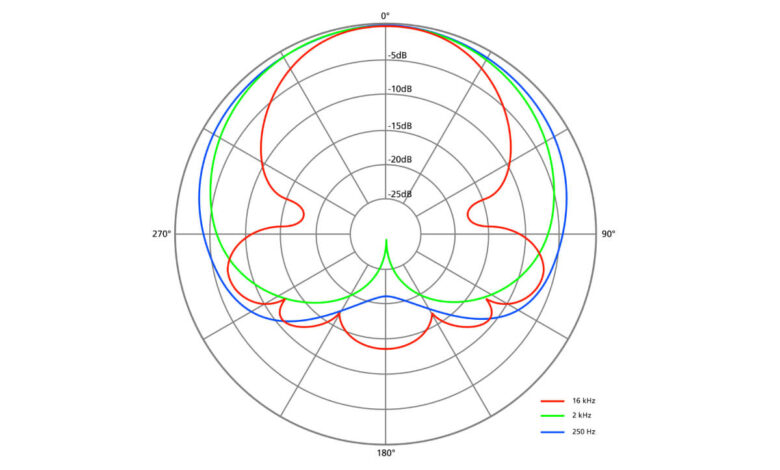
A polar pattern is a map of which directions a microphone hears well and which it hears poorly. Omnidirectional hears all directions equally. Cardioid favors the front and hears least from directly behind. Figure-8 hears front and back but not the sides. Supercardioid and shotgun narrow the front further. No pattern removes room echo; a pattern only lets you point the mic's least sensitive side at a noise.
That last sentence answers the question most people arrive with: which pattern stops the mic hearing my room? The rest of this guide explains each pattern, where each one's dead spot actually sits, and how to use that to your advantage at a desk.
Microphone polar patterns explained in one table
| Pattern | Hears best | Hears least | Good for | Watch out for |
|---|---|---|---|---|
| Omnidirectional | Everywhere equally | Nowhere in particular | Natural room sound, clip-on mics, groups | Picks up the whole room |
| Cardioid | The front | Directly behind | One voice at a desk | The sides still hear a fair amount |
| Supercardioid and hypercardioid | A narrower front | Off toward the rear sides | Noisier spaces, live use | A small pickup lobe directly behind |
| Figure-8 | Front and back | The sides | Two people facing each other | Hears everything behind it |
| Shotgun (lobar) | A narrow front | Most sound from the sides | Aiming at a source from a distance | Very sensitive to aim |
The descriptions below draw on two microphone makers' published explainers, both read September 11, 2026: LEWITT's guide to polar patterns and RODE's overview of microphone polar patterns.
Omnidirectional: hears the whole room
LEWITT describes the omni pattern as having "the same sensitivity to sound pressure coming from any direction," with the best bass response and the least sensitivity to handling noise. RODE says omni mics pick up sound "in a perfect sphere," which gives a natural, realistic result.
That naturalness is the catch for home recording. An omni mic hears your voice and the room at the same sensitivity. In a treated studio that sounds open and airy. In a bare bedroom it sounds like the bedroom.
Omni works well when the mic can sit very close to the source, which is why clip-on lavalier mics are often omni: a few inches from the mouth, your voice dominates anyway. It is also forgiving when a speaker turns their head, since there is no "front" to fall away from.
Cardioid: the default for a single voice
Cardioid is named for its heart shape. LEWITT calls it the most commonly used pattern, "most sensitive at 0° and least sensitive at 180°," with typical rear rejection of about 20 dB, which it translates as sound from behind being picked up at about a tenth of the front sensitivity.
In practice, that makes cardioid the right starting point for one person talking into one mic. You speak into the front, and the back of the mic faces away from you. The sides are reduced but not silent, so a cardioid still hears a good deal of the room, just less of whatever is directly behind it.
If you record at a desk, the most useful thing you can do with a cardioid is decide what sits behind it. A computer, a window or a speaker belongs there. Your own head does not.
Supercardioid and hypercardioid: tighter, with a catch
These are narrower versions of cardioid. LEWITT describes supercardioid as "more directive than a cardioid pattern having a bit more side and a bit less rear rejection." RODE describes both supercardioid and hypercardioid as having "tighter directionality at the front" and picking up smaller levels from the rear and sides.
The catch is where the dead spot moves. A cardioid is least sensitive straight behind. A supercardioid or hypercardioid rejects the sides better but hears a little from directly behind, so its quietest directions sit off toward the rear sides rather than dead center.
That changes placement. If you put a noise source directly behind a supercardioid, expecting cardioid behavior, you may pick up more of it than a plain cardioid would. Angle the noise slightly off the rear axis instead.
Figure-8: front and back, nothing from the sides
LEWITT describes figure-8 as having the same sensitivity at 0° and 180° and the least at 90° and 270°, with "the highest side rejection of all polar patterns." It also has the least bass response and is the most sensitive to wind and handling noise.
It sounds like an odd shape for voice, but it has one excellent home use: two people facing each other across a single mic. Each voice lands on one lobe, and anything off to the sides, such as a window or a door, falls into the gaps.
The cost is that a figure-8 hears as much from behind as from the front. With one person talking, whatever is behind the mic is recorded at full sensitivity, which usually makes it the wrong choice for a solo voice.
Shotgun: narrow, and not magic indoors
RODE calls the shotgun or lobar pattern "the most extreme example of a directional device, with a particularly narrow front pick-up area." That makes it useful for aiming at a speaker from outside a camera frame.
Narrow does not mean it only hears what it points at. It reduces sound arriving from the sides, but in a small room with hard walls, reflections of your voice also arrive from the front, bouncing off the wall behind you and back along the mic's own axis. A shotgun cannot tell those apart from your voice. For a seated voice at a desk, a cardioid worked close usually does the job a shotgun gets bought for.
Why no pattern stops the room
This is the point most explanations leave out. A polar pattern filters sound by direction. Room echo is your own voice arriving from every direction at once, including from the front. So every pattern hears some of the room, because some of the room always arrives from the direction the mic listens to best.
What does reduce the room is distance. Your direct voice gets much louder as you move closer to the capsule, while the reflections stay about the same, so the voice-to-room ratio rises. The pattern is a second lever: it controls what arrives from behind and beside the mic.
Headphone leakage is a good example of that second lever. Sound from open headphones spills out right beside the mic. A cardioid pointed away from your ears reduces it; an omni or figure-8 hears it fully. That is one reason closed-back headphones are the usual choice while recording.
Aim the dead spot, not just the front
Once you know where each pattern is deaf, placement becomes a free fix. Identify your loudest unwanted sound first, the way you would name your noise before choosing ANC or noise isolation for headphones, then turn the quiet side of the mic toward it.
| Unwanted sound | Pattern | Where to point the quiet side |
|---|---|---|
| Computer fan under or beside the desk | Cardioid | Rear of the mic toward the computer |
| Window or door to one side | Figure-8 or supercardioid | Side of the mic toward the window |
| Speakers in front of you, behind the mic | Cardioid | Rear of the mic toward the speakers |
| A second person across the table | Figure-8 | One lobe per person |
The front of the mic stays pointed at your mouth. What you rotate is everything else.
Proximity effect: why close can sound bassy
Directional patterns have a side effect: move very close and the bass rises. This is called proximity effect, and it shows up on directional mics rather than true omni ones. LEWITT's descriptions reflect the same physics, noting that omni offers the best bass response and that wide cardioid suits vocals "that need little proximity effect."
For voice, a little proximity effect can sound warm. Too much sounds boomy. If working close to a cardioid mic makes you sound muddy, back off slightly or use the low-cut filter many mics and interfaces include.
Multi-pattern mics: check the switch
Some mics offer several patterns through a switch or a software setting. If a multi-pattern mic sounds unexpectedly roomy, check that it has not been left on omni or figure-8. It is a common cause and the easiest fix on this page.
Headset boom mics avoid most of these questions by keeping a directional capsule close to your mouth, which is part of the difference between a gaming headset and a separate mic.
FAQ
Which polar pattern is best for podcasting?
Cardioid for one person per mic. It hears the front, rejects the rear and is the most common pattern on voice mics. Two people sharing one mic face to face is the case for figure-8.
Does a cardioid mic block background noise?
It reduces sound from behind, by about 20 dB on a typical cardioid according to LEWITT, but it still hears the sides and the front. Put the noise behind the mic and work close.
Is a shotgun mic good for recording at a desk?
Usually not the best choice. In a small room, reflections arrive from the front too, and a cardioid worked close tends to be simpler and just as effective.
Why does my cardioid mic still sound roomy?
Distance. Every pattern hears the room from the front. Move closer and reduce the gain to match.
The short version
Patterns filter by direction, not by distance. Choose cardioid for a single voice, figure-8 for two people facing each other, and omni only when the mic can sit very close. Then turn the pattern's quiet side toward your loudest noise, and use distance to deal with the room.


