A good pair of bookshelf speakers will beat a soundbar on music at similar money, and can still lose to it on television. The reason is not build quality, it is channel layout. A stereo pair has no center channel, so dialogue has to be produced between the two speakers, and that only works properly from a seat in the middle. A soundbar with a real center channel puts speech in a dedicated driver aimed at the whole sofa. So the honest split is this: if the system is mostly for music and one listening seat, choose bookshelf speakers. If it is mostly for TV watched by more than one person, choose the bar.
Everything below is about the details that change that default.
The two things they are each built for
These are not two versions of the same product. They are optimized for different jobs.
A soundbar is optimized around the television. It is a wide, shallow enclosure designed to sit under a screen, aimed at a sofa, with processing built specifically for film soundtracks: dialogue modes, night modes, surround virtualization. On better bars, the middle section is a genuine center channel with its own drivers.
A bookshelf pair is optimized around a stereo image. Two boxes, placed apart and toed in toward one seat, producing a soundstage between them. This is the layout recorded music has been mixed for since stereo existed, and it is why a decent pair is startling on music in a way a bar rarely is.
Apply the wrong one to the wrong job and the strength becomes the weakness.
The dialogue problem nobody warns you about
Here is the finding that surprises people who upgrade from a bar to "proper speakers" and end up disappointed.
Film and television sound is mixed with most dialogue placed in the center channel, on purpose, so speech stays anchored to the screen no matter where in the room you sit. A stereo pair has no center. Your equipment therefore folds the center channel into left and right, and the center is reproduced as a phantom image that only forms correctly if your head is roughly equidistant from both speakers.
Sit in the middle and it works. Sit at either end of a three-seat sofa and the phantom center collapses toward the nearer speaker, and dialogue drifts sideways and gets harder to follow. Meanwhile a 3.1 soundbar has a real center driver pointed at the whole seating area and does not have this problem at all.
So "better speakers, worse dialogue" is a real and common outcome, not a fault. If you already struggle to follow speech, the fix that helps most is usually not better speakers, and this site covers it separately in soundbar dialogue too quiet.
What a bookshelf setup actually requires
The comparison is often written as one box against two boxes. It is not. A passive bookshelf pair needs several things a soundbar has built in.
- Amplification. Passive speakers have no amplifier. You need a stereo amplifier or receiver. This site explains the distinction in do I need an amplifier and a receiver.
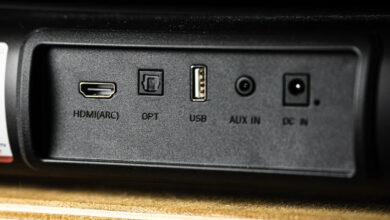
- A way to get audio out of the TV. This is the gate people hit late. Many modern televisions have no analog audio output at all, only optical and HDMI. A plain stereo amplifier usually has neither, which means you also need a converter or an amplifier with a digital input. Which output your TV has and what it can carry is covered in optical audio vs HDMI ARC.
- Stands or a surface at the right height. Tweeters want to be near ear height when seated, and speakers want to be clear of the wall and clear of the TV. A shelf under the screen is not the same as a proper position.
- Bass. Small bookshelf speakers roll off in the low end. Most film soundtracks assume a subwoofer. Many soundbars ship with one.
Powered (active) bookshelf speakers change this arithmetic considerably. They contain their own amplification and often accept an optical input directly, which collapses three of the four requirements above into one purchase. If you are drawn to the bookshelf route but not to assembling a chain, that is the version worth looking at. For the general background on the format, see what are bookshelf speakers.
Side by side
| Soundbar | Bookshelf pair | |
|---|---|---|
| Best at | TV, film, dialogue | Music, stereo imaging |
| Center channel | Yes on 3.x models and above | No, phantom center only |
| Seats served well | Whole sofa | Roughly one |
| Boxes to place | One, plus optional sub | Two, plus stands, plus amp, plus sub |
| Connects to a modern TV | Directly, one cable | Needs a digital input or a converter |
| Surround capability | Virtual, or real with add-on rears | None without adding more equipment |
| Upgrade path | Replace the unit | Swap speakers or amplifier independently |
| Visual footprint | Low and hidden | Prominent |
Choosing: three questions
Question 1: what is it mostly for?
Be honest about the split. If it is 80 percent television, buy for television. If you listen to albums properly, seated, more evenings than not, buy for music. Most people's answer to this is not the one they would like it to be.
Question 2: how many people watch at once, and where do they sit?
One person, one chair, centered: the phantom center works and bookshelf speakers are viable for TV too. Two or three people across a sofa: the center channel advantage of a bar is substantial and grows with room width.
Question 3: what will actually get set up and stay set up?
A bookshelf system with the speakers pushed against a wall, sitting on the TV unit at knee height, with the amplifier on the floor, is not what the reviews were describing. If you cannot give the speakers stands and space, most of the reason to prefer them has been given away before you press play.
The middle answer, and why it is common
There is a third option the comparison format tends to hide: a soundbar for the television and a small separate stereo system for music, not necessarily in the same room. That is often the better use of the same money, because each system is doing the job it was designed for rather than compromising at both. It is also how a lot of people who care about both end up living, after trying to make one system do everything.
If you want to keep the option of scaling toward real surround later, that decision belongs with the wider chain rather than with the speakers alone, and the TV sound chain lays out how the pieces connect.
What we cannot tell you here
We do not test products on this site, we do not recommend specific models, and we do not quote prices, because none of those would be honest coming from us. Everything above is mechanism and layout, which is the part that stays true regardless of which brand you are looking at.
Two genuine uncertainties remain. Speaker quality varies enormously within both categories, so a good soundbar can and does beat a poor bookshelf pair on every count including music. And room acoustics affect a stereo pair more than they affect a bar, which means the same speakers can be excellent in one room and disappointing in another, in ways no article can predict for you.
FAQ
Are bookshelf speakers better than a soundbar?
For music, usually yes at comparable spend. For television watched by several people, often no, because a stereo pair has no center channel and dialogue depends on a phantom center that only forms properly for a centrally seated listener.
Can I connect bookshelf speakers directly to my TV?
Passive ones, no. They need an amplifier, and most modern televisions no longer have an analog audio output to feed one, so you usually need an amplifier with a digital input or a separate converter. Powered bookshelf speakers with an optical input avoid this.
Do I still need a subwoofer with bookshelf speakers?
For film, generally yes. Small bookshelf cabinets do not reproduce the low end that soundtracks assume. For music at moderate volume, a good pair can be satisfying on its own.
Will bookshelf speakers give me surround sound?
Not by themselves. A stereo pair produces two channels. Surround requires additional speakers and a receiver to drive them, which is a larger project than swapping a soundbar.
What if my seating is off to one side of the room?
That argues strongly for a soundbar. Off-axis seating is where the phantom center of a stereo pair breaks down and dialogue starts pulling toward the nearer speaker.