

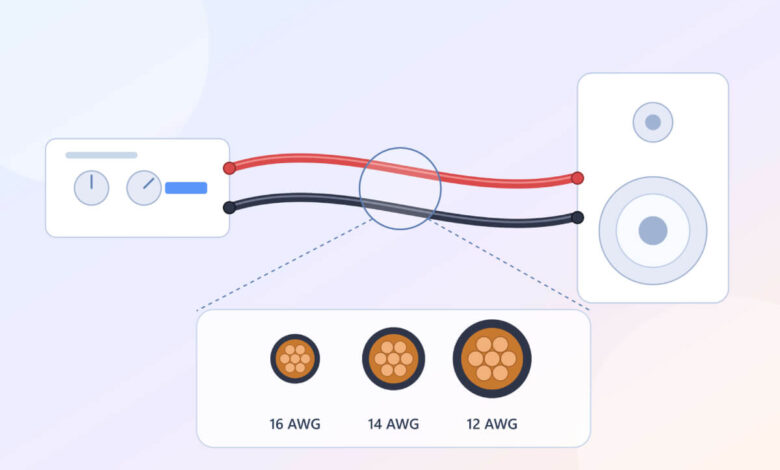
Short answer: gauge matters because it sets the wire’s resistance, and resistance matters in proportion to how long the run is and how low your speakers’ impedance is. Short runs to ordinary speakers work fine with ordinary copper wire of a sensible gauge. Long runs, low impedance speakers, and powerful amplifiers are where a thicker wire (a lower gauge number) earns its place. Crown, the amplifier maker, says runs of 25 feet or less generally work well with 14 gauge and that longer runs should use 12 gauge if possible. Beyond getting resistance low enough, a higher price buys you little that physics can explain.
What gauge actually measures
Speaker wire in the US is sized in AWG, American Wire Gauge. The number runs backwards: a lower number is a thicker wire. So 12 gauge is thicker than 14, which is thicker than 16, which is thicker than 18.
Thickness matters for one reason. A thicker conductor has less electrical resistance per foot, and resistance in the speaker cable does two things you do not want:
- It wastes power. Some of the amplifier’s output turns into heat in the wire instead of sound at the speaker.
- It loosens the amplifier’s control of the speaker. Engineers call this damping. The amplifier holds the speaker cone most tightly when the connection between them has very little resistance. Extra resistance in the cable weakens that grip.
A third, quieter effect follows from the second. A speaker’s impedance is not one fixed number; it rises and falls across the frequency range. A cable with meaningful resistance forms a small divider with that changing load, which can nudge the frequency response. With short, adequately sized wire the effect is tiny. With long, thin wire it becomes something a careful system builder avoids.
The three things that decide whether gauge matters for you
Gauge is never the whole question. It always interacts with two other variables.
1. Run length, counted properly
Resistance grows in direct proportion to length. Remember that the signal travels out on one conductor and back on the other, so the circuit is twice the distance between amplifier and speaker. A 30 foot run to a rear surround speaker is 60 feet of conductor in the circuit.
Measure the route the wire will actually take, around doors, along baseboards, up and over, not the straight line across the room. That route is almost always longer than you expect, and rear speakers in a surround setup are where the longest runs live. If you are still planning which layout your room can support, the guide to 5.1 vs 7.1 vs Atmos room requirements shows where those rear runs end up.
2. Speaker impedance
What matters is not the wire’s resistance alone but how large it is compared with the speaker’s impedance. The same cable is a bigger fraction of a 4 ohm load than of an 8 ohm load, so a low impedance speaker is more sensitive to thin or long wire. If your speakers are rated at 4 ohms, treat any length guideline as needing a thicker wire than it would for 8 ohm speakers.
3. Amplifier power
Crown’s FAQ on wire gauge says plainly that the larger the amplifier, the heavier the gauge you will want. More power means more current through the same resistance, which means more loss in absolute terms.
What an amplifier maker actually recommends
Crown makes professional power amplifiers, and its answer to “What gauge speaker wire should I use in my system?” is one of the clearest manufacturer statements available. It says that for the best speaker damping and least power loss you should use the heaviest gauge that is practical, that runs of 25 feet or less generally work well with 14 gauge, and that runs over 25 feet should use 12 gauge if possible. Crown adds that “these numbers are not set in stone, but generally work well.”
Two things are worth noticing about that guidance:
- It is written for amplifiers that can deliver a lot of power. A modest home stereo amplifier driving efficient speakers at living room levels is a gentler case, so this advice has headroom built in for a typical home system.
- It says nothing about exotic construction. Crown’s recommendation is about gauge and length, the things that set resistance. It does not tell you to buy a special cable geometry, a premium conductor, or a particular brand.
Crown also notes that constant voltage systems, the 70.7 volt or 140 volt distributed setups used for ceiling speakers in commercial buildings, carry low current, and that 18 gauge wire often works well there. That is a different kind of system from a home stereo, so do not apply the 18 gauge figure to a normal amplifier and speaker pair.
A decision procedure for your own runs
Work through these steps instead of reaching for a chart first.
| Step | What you do | Why |
|---|---|---|
| 1 | Measure the real route from amplifier to speaker, then add slack for the terminals | The straight line underestimates the run |
| 2 | Note each speaker’s nominal impedance from its label or manual | Lower impedance makes wire resistance matter more |
| 3 | Start from Crown’s baseline: 14 gauge up to 25 feet, 12 gauge beyond | A named manufacturer baseline, not a guess |
| 4 | Go one size thicker for 4 ohm speakers, a high power amplifier, or a run near the limit | Each of these raises the stakes of resistance |
| 5 | Confirm the terminals accept the thickness you picked | Very thick wire may not fit some spring clip terminals |
| 6 | Use the same gauge and similar length on left and right | Keeps the pair behaving alike |
If a run is truly long, the better fix is often to move the amplifier closer to the speakers, or to use powered speakers with the amplifier built in, rather than chase an ever thicker cable.
Copper versus copper clad aluminum
Not all wire labeled with the same gauge performs the same. Some budget speaker wire is copper clad aluminum (CCA): an aluminum core with a thin copper coating. Aluminum conducts less well than copper, so a CCA wire has more resistance than a solid copper wire of the same gauge.
Check the jacket or packaging. It should say whether the conductor is copper or CCA. If it is CCA, treat it as a thinner wire than its gauge number suggests and size up. This single check matters more than most of the claims printed on premium cable boxes.
Is expensive speaker wire a scam?
“Scam” is too strong for every case, but the honest summary is this: the properties of a speaker cable that clearly matter are the ones that set resistance, namely gauge, conductor material, and length. Once those are adequate for the run, a manufacturer that claims an audible improvement from something else owes you evidence, ideally a controlled listening test, not a description of how its cable is built.
What a higher price can legitimately buy:
- A thicker gauge than the budget option.
- Solid copper instead of CCA.
- A jacket rated for in-wall or outdoor use.
- Better terminations, such as properly crimped pins or banana plugs that make a tight, reliable contact.
What a higher price cannot change is the physics of resistance. A generic copper wire of the right gauge and a boutique cable of the same gauge and length present similar resistance to the amplifier. If you want to spend on something that audibly changes a room, speaker position and room setup do more. The guide to placing a subwoofer in a small room is a good example of where that money and effort go further.
Where cable length rules show up elsewhere
The idea that length and conductor size together decide performance is not unique to speakers. It is the same reasoning behind how coaxial cable length affects signal quality, although coax carries a very different kind of signal. With speaker wire the concern is simple resistance at audio frequencies, which is why gauge and length, not exotic design, are the variables that count.
In-wall and outdoor runs are a separate question
Gauge tells you how well a wire carries the signal. It tells you nothing about whether that wire is allowed inside a wall or outdoors. Wire run inside walls and ceilings generally needs a jacket carrying an in-wall rating printed on it, and wire run outdoors or buried needs a jacket made for that environment. Building codes differ by location and by edition, so check the rating your local code requires with your local building inspector or a licensed electrician before you run anything through a wall. Never share a box or conduit with mains power wiring.
What gauge cannot fix
- A loose or oxidized connection. A frayed end or a corroded terminal can add more resistance than the entire wire run. Keep ends clean, tight and trimmed.
- A wiring mistake. Swapping positive and negative on one speaker (reversed polarity) makes bass sound thin, and no gauge upgrade fixes that. Check the marking on the wire and match it at both ends.
- A mismatch between amplifier and speakers. If your speakers’ impedance is below what the amplifier supports, a thicker wire will not make the pairing safe.
FAQ
What gauge speaker wire do I need for a home stereo?
For typical runs, Crown’s guidance is a good baseline: 14 gauge for runs of 25 feet or less and 12 gauge for longer runs. Size up for 4 ohm speakers or a high power amplifier.
Is 16 gauge speaker wire good enough?
For short runs to 8 ohm speakers at normal listening levels it is commonly used. For long runs, low impedance speakers, or powerful amplifiers, a thicker 14 or 12 gauge wire keeps resistance lower. Crown recommends the heaviest gauge that is practical.
Does thicker speaker wire improve sound quality?
It reduces resistance, which reduces power loss and keeps the amplifier’s control of the speaker tight. Once resistance is low enough for the run, going thicker still has little further effect.
Is copper clad aluminum speaker wire bad?
It is not dangerous, but it has more resistance than solid copper of the same gauge. If you use it, choose a thicker gauge than you would for copper.
Should left and right speaker wires be the same length?
Keeping them the same gauge and similar length keeps the two channels behaving alike. A small difference in length on short runs is not a problem.


