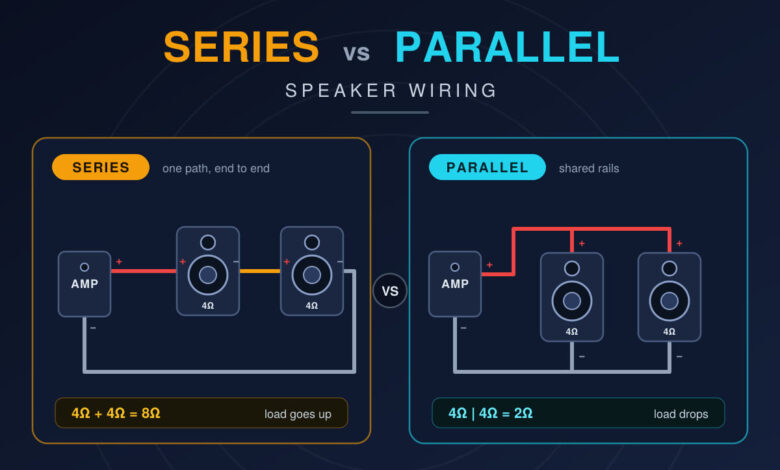
The difference between series vs parallel speaker wiring is what happens to the load your amplifier sees. In series, the signal passes through one speaker and then the next, and the impedances add up, so two 8-ohm speakers become a 16-ohm load. In parallel, each speaker connects directly to the same terminals, and the load drops, so two 8-ohm speakers become 4 ohms. Parallel is louder but harder on the amp. Series is gentler on the amp but quieter. The safe choice is whichever keeps the load at or above your amplifier’s minimum rated impedance.
Series vs parallel speaker wiring at a glance
| Series | Parallel | |
|---|---|---|
| How it connects | Amp positive to speaker A positive, speaker A negative to speaker B positive, speaker B negative back to amp negative | Every positive terminal to positive, every negative to negative, all on the same amp terminals |
| What happens to the load | Impedances add | Load drops below any single speaker’s rating |
| Two identical 8-ohm speakers | 16 ohms | 4 ohms |
| Two identical 4-ohm speakers | 8 ohms | 2 ohms |
| Effect on the amplifier | Easier load, less power delivered | Harder load, more current drawn |
| If one speaker’s circuit breaks open | The whole chain goes silent | The other speaker keeps playing |
| Main risk | Low volume and uneven sound | Dropping below the amp’s minimum impedance |
How series wiring works
In a series circuit there is only one path for the signal. It leaves the amplifier’s positive terminal, goes into the first speaker, comes out of that speaker’s negative terminal, goes into the second speaker’s positive terminal, and finally returns from the second speaker’s negative terminal to the amplifier.
Speco Technologies describes the connection in its guide How to wire speakers in series and parallel (Ohm’s Law) by Tyler Rowe: “connect the positive wire to speaker A’s positive terminal, connect a wire from speaker A’s negative terminal to speaker B’s positive wire,” continuing the chain from there. On the load, the same guide is direct: “The impedances add in a series connection.”
That is why series wiring is the tool for raising a load. If an amplifier needs to see at least 8 ohms and you have two 4-ohm speakers, series wiring presents 8 ohms.
The catch is that raising the load lowers the power the amplifier delivers into it, and the two speakers share what is left. Series pairs often sound noticeably quieter than either speaker alone on the same volume setting.
How parallel wiring works
In a parallel circuit, each speaker has its own path back to the amplifier. Speco puts it simply: “Speakers are wired in parallel by hooking the positive terminals to positive terminals and negative terminals to negative terminals.” In practice, that often means two sets of wires meeting at the same amp terminals, or one speaker’s terminals being linked on to the next.
The load goes the other way. Speco’s rule for identical speakers is: “If all of the speakers have a common impedance, you can simply divide the common impedance by the total number of speakers.” Two 8-ohm speakers give 4 ohms. Three give about 2.7 ohms. Four give 2 ohms.
Parallel wiring is the more common way speakers end up sharing a channel, often by accident. Plugging a second pair of speakers into the same terminals, or switching on an amp’s A and B outputs together, usually creates a parallel load. That is why the parallel column is where most amplifier trouble starts.
Which one to use: a decision in four questions
Choose the wiring from the amplifier’s rating, not from what is quicker to connect.
- What is your amplifier’s minimum rated impedance per channel? Find it near the speaker terminals or in the specifications. If you cannot find it, stop and contact the manufacturer.
- What are the speakers rated at? Use the nominal impedance printed on each speaker’s terminal plate.
- What load does each option give? Work out both. Series: add the ratings. Parallel with identical speakers: divide one rating by the number of speakers.
- Which options are at or above the minimum? Any option below it is ruled out. If both qualify, parallel generally gives more volume, and series gives the amp an easier time.
A worked example: an amplifier rated for 4 to 16 ohms and two 8-ohm speakers on one channel. Parallel gives 4 ohms, which is at the minimum, so it is within spec, though running it hard leaves little margin. Series gives 16 ohms, well within spec but quieter. The same two speakers on an amp rated only for 8 ohms leave series as the only option that stays inside the rating.
Series-parallel: combining both
With four identical speakers you can use both methods at once. Wire the speakers into two series pairs, then connect those two pairs in parallel. Speco’s guide demonstrates this kind of combination, where two networks are combined so the total lands back at the rating the amplifier expects.
With four 8-ohm speakers: each series pair is 16 ohms, and two 16-ohm pairs in parallel make 8 ohms. The amplifier sees the same load as a single 8-ohm speaker, while four speakers share the output.
Series-parallel only works cleanly when all the speakers are identical. It also has more connections to get right, and a single reversed wire can leave one pair out of phase with the other, which thins out the bass.
What most wiring guides leave out
These practical differences rarely make the diagrams, but they shape how each option behaves in a real room.
What happens when one speaker fails
A series circuit has one path. If one speaker’s voice coil breaks open or a connection comes loose, the circuit is broken and every speaker in that chain goes silent. A parallel circuit keeps working, because each speaker has its own path. The flip side is that a shorted speaker or stray strand in a parallel setup puts a near-zero load across the amplifier’s output, which is exactly the fault protection circuits exist to catch.
Mixing different speakers
With unequal speakers, neither method shares power evenly. In series, the speaker with the higher impedance takes a larger share. In parallel, the lower-impedance speaker draws more current. A speaker’s impedance also varies with frequency, so two different models in series can change each other’s tonal balance, not just their volume. Mixing speakers on one channel is best avoided unless the manufacturer of the amplifier or speakers documents the combination.
Why a multimeter will not confirm your total
It is tempting to check the result with a multimeter across the amp’s speaker wires. It will not give you the nominal figure. Speco warns that “Impedance cannot be measured with an ohmmeter (multi-meter) as it is frequency dependant.” A meter reads the DC resistance of the voice coils, which comes out lower than the rated impedance. Use the meter to spot a dead short or an open circuit, and use the ratings and the arithmetic above to work out the load.
Where you will actually meet series and parallel
At home, series and parallel choices most often come up with a second pair of speakers on a stereo amp, extra ceiling or outdoor speakers, and dual voice coil subwoofers, which have two sets of terminals so the owner can wire the coils in series or parallel to suit the amplifier. Guitar and bass speaker cabinets use the same rules. Whole-building systems with many speakers usually use a different approach entirely, designed by an installer, rather than long chains of series or parallel wiring.
If you are still deciding between speaker types, our comparison of soundbars and bookshelf speakers explains which setups use passive speakers that need this kind of wiring at all.
Wiring safely
Speaker-level wiring is low voltage compared with mains power, but mistakes can still damage equipment.
- Power down first. Switch the amplifier off and unplug its power cord before connecting or changing any speaker wires.
- Keep strands under control. Twist the bare copper ends tight, prepare them away from the amplifier, and check that no loose strand bridges the positive and negative terminals or touches the chassis.
- Keep polarity consistent. Positive to positive and negative to negative throughout, except for the deliberate positive-to-negative links inside a series chain.
- Start at low volume after any change, and listen for distortion or clicks before turning up.
Stop and unplug the amplifier if it enters protection mode, gets much hotter than usual, blows a fuse or gives off a hot or burning smell. Recheck the load and the wiring once it has cooled. If the problem continues with wiring that is within the amp’s rating, the amplifier needs a qualified audio repair technician. Do not open a mains-powered amplifier to investigate.
Frequently asked questions
Is series or parallel better for speakers?
Neither is better in general. Parallel gives more volume but lowers the load, while series raises the load but lowers the volume. The better choice is whichever keeps the load on each amplifier channel at or above its minimum rated impedance.
What do two 8-ohm speakers in parallel equal?
Two identical 8-ohm speakers in parallel present a 4-ohm load. Only connect them that way if your amplifier is rated for 4 ohms per channel.
What do two 4-ohm speakers in series equal?
Two identical 4-ohm speakers in series present an 8-ohm load, because impedances add in a series connection.
Why is one pair of my speakers quieter than the other?
If the quieter pair is wired in series, that is expected, because a higher load draws less power. It can also mean the speakers are different models or one connection is poor. Check the wiring and ratings before turning the volume up to compensate.
Can I check the total impedance with a multimeter?
Not accurately. A multimeter measures DC resistance, which reads lower than a speaker’s nominal impedance. It is useful for finding a short or a broken connection, but the load should be worked out from the speakers’ ratings.