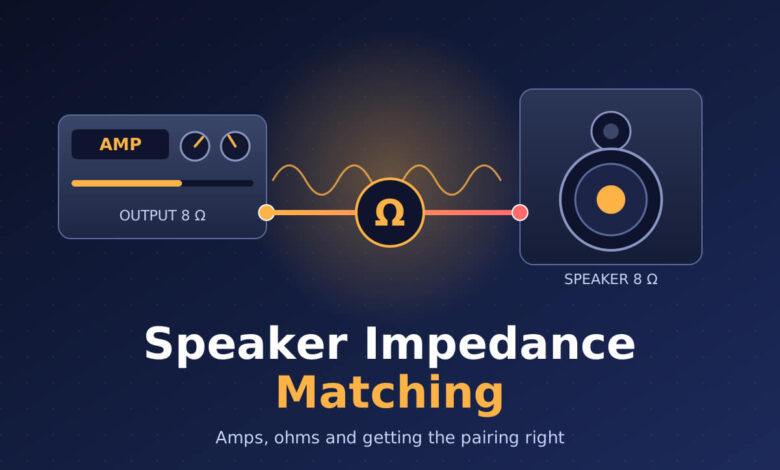
Speaker impedance matching means making sure your speakers’ impedance, measured in ohms, is at or above the minimum your amplifier is rated for. A speaker with a higher rating than the amp’s minimum is safe, though it may play a little quieter. A speaker with a lower rating makes the amp work harder and can lead to overheating, distortion or damage. So 8-ohm speakers on an amp rated for 4 ohms are fine, while 4-ohm speakers on an amp rated only for 8 ohms are a risk you should avoid.
What speaker impedance actually is
Impedance is how much a speaker opposes the electrical signal from the amplifier. ELAC’s knowledge base article How to Match Amplifier & Speaker Impedanceputs it plainly: “Most speakers are rated at 4Ω, 6Ω, or 8Ω. The lower the impedance, the more demanding it is on the amplifier.”
The key detail is the word “nominal.” A speaker’s impedance is not a fixed number. ELAC explains that “impedance varies with frequency, so manufacturers provide a ‘nominal’ impedance value.” In practice, a speaker labeled 8 ohms dips below that at some frequencies and rises above it at others. The nominal figure is a summary for matching purposes, not a promise about every note.
Why lower is harder: at the same volume setting, a lower-impedance load draws more current from the amplifier. More current means more heat in the amp’s output stage. That is the whole reason the rating matters.
The speaker impedance matching rule in one table
ELAC’s golden rule is to “match the speaker’s nominal impedance to the amplifier’s rated impedance whenever possible.” When an exact match is not possible, the direction of the mismatch decides whether it is safe.
| Your pairing | Example | What happens | Verdict |
|---|---|---|---|
| Same impedance | 8-ohm speakers, amp rated for 8 ohms | The amp works as designed | Safe, the ideal case |
| Speaker higher than amp’s minimum | 8-ohm speakers, amp rated down to 4 ohms | The amp works less hard; output may be slightly lower | Safe |
| Speaker lower than amp’s minimum | 4-ohm speakers, amp rated only for 8 ohms | The amp can be overworked, overheat or distort | Avoid |
ELAC’s page is candid that the last row is a real risk. Its quick guide calls it “Risky” and says it “can cause amp strain or speaker damage,” then adds “If unavoidable, keep volume low.” Its final tips are firmer: “Never connect speakers with lower impedance than the amplifier’s minimum rating.” The safest reading of that is simple. Treat a lower-impedance speaker on an amp not rated for it as something to fix, not something to manage by being careful with the volume knob.
Step by step: is your pairing safe?
This is the decision procedure most impedance explainers leave out. Work through it before you connect anything new.
- Find the amplifier’s minimum rated impedance. Look on the back panel near the speaker terminals and in the owner’s manual. It is often written as a range such as “4 to 16 ohms” or as a minimum such as “6 ohms min.”
- Find each speaker’s nominal impedance. It is usually printed on the terminal plate on the back of the speaker and in its specifications.
- Work out the load per channel. If you are connecting one speaker per channel, the load is simply that speaker’s rating. If you are connecting more than one speaker to the same channel, see the next section, because the wiring changes the load.
- Compare. If the load per channel is equal to or higher than the amp’s minimum, the pairing is within spec. If it is lower, it is not.
- Check for an impedance setting. Some AV receivers have an impedance switch or menu setting. Set it according to the manual, not by guesswork.
- If you cannot find a rating, stop. An unknown number is not a safe number. Contact the manufacturer’s support with the model numbers before connecting.
Always make speaker connections with the amplifier switched off and unplugged. Yamaha’s instructions for setting speaker impedance on its RX-V385 receiver, for example, end with switching to standby and disconnecting the power cable from the outlet before the speakers are connected.
Two speakers on one channel: how the load changes
Adding speakers is where most accidental mismatches happen, because the combined load is not the same as either speaker’s rating.
- In parallel (both speakers connected directly to the same pair of terminals), the combined load drops. Two identical 8-ohm speakers in parallel present 4 ohms. Two identical 4-ohm speakers in parallel present 2 ohms.
- In series (the signal passes through one speaker and then the other), the combined load rises. Two identical 8-ohm speakers in series present 16 ohms.
So “adding a second pair” to a stereo amp by wiring them to the same terminals can quietly halve the load. An amp rated for 8 ohms that was happy with one pair of 8-ohm speakers is now driving 4 ohms per channel, below its rating. If your amplifier has separate A and B speaker outputs, check whether its manual gives a different minimum impedance for using both at once, and follow that figure.
Series wiring raises the load but also changes how the speakers interact and reduces the power each receives. It solves the safety problem, not necessarily the sound problem.
What AV receiver impedance switches really do
Receiver impedance settings confuse people because they sound like they “enable” lower-impedance speakers.
Yamaha’s owner’s manual page Setting the speaker impedance for the RX-V385 says that under its default settings the unit is configured for 8-ohm speakers, and that when connecting 6-ohm speakers you should set the impedance to “6 Ω MIN.” The page marks this setting as applying to U.S.A. and Canada models only, and the same manual’s speaker requirements page says other regional models need speakers of at least 6 ohms.
Two lessons come from that. First, the setting exists for the speaker ratings the manufacturer lists, and following the manual is the safe path. Second, the same model can carry different guidance in different regions, so read the manual for your exact model and region rather than a forum post about a similar receiver.
Warning signs that something is wrong
Stop and switch the amplifier off if you notice any of the following:
- The amp goes into protection mode (clicks off, flashes a warning or shuts down) during normal listening.
- The case gets much hotter than usual or a hot smell appears.
- Sound distorts at volumes that used to be clean.
- A fuse blows or a speaker suddenly goes silent.
- Any burning smell or smoke. Unplug the amplifier at the wall if it is safe to reach, keep away from the unit, and do not switch it back on.
Once the unit has cooled, check the impedance, the wiring and whether any bare strands of speaker wire could be touching across terminals. If the problem continues with a correct, within-spec pairing, the amplifier needs a qualified audio repair technician. An amplifier is mains-powered equipment, and its inside is not a place for home repairs. Our guide to what a stereo receiver does covers the basics of how the unit is laid out from the outside.
Power ratings depend on impedance too
An amplifier’s wattage is quoted at a specific impedance. ELAC gives the example of an amplifier that “might deliver 100 watts at 8Ω and 150 watts at 4Ω,” and advises that continuous power, “not peak or dynamic power,” is the most reliable indicator. When comparing an amp with a speaker’s recommended power range, compare figures at the same impedance.
That ELAC example is only an illustration of how specs are written. The real figures for your amp are in its own specification sheet, and if an amp lists no figure at a lower impedance, do not assume it is designed for that load.
What impedance matching will not do
Getting impedance right keeps your amp within its design limits. It does not guarantee great sound, and it does not protect against everything. Driving any amp into audible distortion by turning it up too far can still harm speakers, even with a correct impedance match. Speaker sensitivity, room size and power headroom all affect how hard the amp has to work.
Impedance also means something different with headphones, where the question is usually whether a source can deliver enough voltage rather than whether it will overheat. If that is your situation, our article on high-impedance headphones sounding quiet on a phone covers it.
Frequently asked questions
Will 4-ohm speakers damage my 8-ohm amplifier?
They can. A 4-ohm load makes an amp rated only for 8 ohms work harder, which can cause overheating, distortion or damage. ELAC’s guidance says never to connect speakers with lower impedance than the amplifier’s minimum rating. Check your manual first.
Can I use 8-ohm speakers on a 4-ohm amp?
Yes, if the amp is rated down to 4 ohms, 8-ohm speakers are within its range. ELAC describes this pairing as acceptable, with possibly slightly reduced volume.
What about 6-ohm speakers?
Follow your amplifier’s manual. Some receivers have a specific setting for 6-ohm speakers. Yamaha’s RX-V385 manual, for example, says to select “6 Ω MIN” when connecting 6-ohm speakers on U.S.A. and Canada models.
Does wiring two speakers together change the impedance?
Yes. Two identical speakers in parallel halve the load, so two 8-ohm speakers become 4 ohms. Two in series double it, so two 8-ohm speakers become 16 ohms. Always work out the combined load before connecting.
Why is my amp shutting off after I connected new speakers?
Protection circuits can trip when an amplifier is overloaded, overheated or sees a short across its outputs. Switch off, check the speakers’ impedance against the amp’s minimum, and inspect the wiring for stray strands. If it continues with a correct setup, contact the manufacturer or a qualified repair technician.