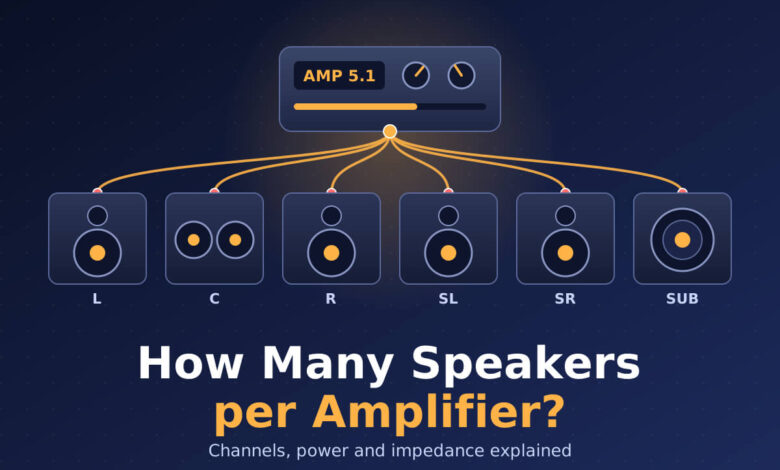
Most home amplifiers are designed for one speaker per channel, so a stereo amp drives two speakers and a 5.1 receiver drives five plus a powered subwoofer. You can add more, but the real limit is not a count. It is the combined load, in ohms, that each channel sees. Extra speakers wired to the same terminals usually lower that load, and once it drops below your amplifier’s minimum rated impedance the amp works harder, runs hotter and can shut down or be damaged. So the honest answer to how many speakers per amplifier is: as many as keep every channel at or above its rated minimum.
Why the question is really about load, not numbers
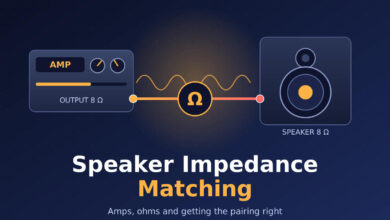
An amplifier does not know how many boxes are attached to it. It only “sees” one electrical load per channel. That load is measured in ohms, and it is the thing the amplifier’s rating is written around.
ELAC’s knowledge base article How to Match Amplifier & Speaker Impedance gives the rule that matters most here: “Never connect speakers with lower impedance than the amplifier’s minimum rating.” ELAC also advises that you “Always refer to both your amplifier and speaker manuals for impedance ratings.”
Here is why adding speakers can break that rule without you noticing. One 8-ohm speaker on a channel is an 8-ohm load. Two identical 8-ohm speakers connected to the same pair of terminals are wired in parallel, and the channel now sees 4 ohms. A lower load draws more current from the amplifier at the same volume setting, and more current means more heat in the output stage. The speakers did not change. The load did.
The short answer by amplifier type
| Amplifier type | Designed for | Before adding speakers, check |
|---|---|---|
| Stereo integrated amp or receiver | One speaker per channel, two in total | The minimum impedance printed near the speaker terminals |
| Stereo amp with Speaker A and B outputs | One pair on A, one pair on B | The separate minimum the manual gives for using A and B at the same time |
| AV receiver | One speaker per channel, plus a powered subwoofer on its own line output | Whether the manual allows a lower-impedance setting, and for which channels |
| Multi-channel power amplifier | One speaker per channel, sometimes with a bridged mode | The per-channel and bridged minimum impedance, which are usually different |
The “check” column is the whole point. A count of terminals tells you how many connections are physically possible. Only the impedance rating tells you what is safe.
How many speakers per amplifier: the per-channel load check
Work through this before you connect anything new. It takes a pencil, the amp’s manual and the labels on the back of your speakers.
- Find the amplifier’s minimum rated impedance. It is usually printed beside the speaker terminals and in the specifications, often as “4 to 16 ohms” or “6 ohms min.”
- Find each speaker’s nominal impedance. Look on the terminal plate on the back of the speaker or in its specifications. Common ratings are 4, 6 and 8 ohms.
- Decide how the extra speaker would connect. If it would share the same terminals as an existing speaker, it is in parallel. If the signal would pass through one speaker and then the other, it is in series.
- Work out the load per channel using the table below.
- Compare. If the load per channel is equal to or higher than the amp’s minimum, the plan is within spec. If it is lower, change the plan.
- If any rating is missing, stop. An unknown number is not a safe number. Contact the manufacturer’s support with both model numbers before connecting.
For identical speakers, the arithmetic is simple. In parallel, divide one speaker’s rating by the number of speakers. In series, add the ratings together.
| Speakers on one channel (all 8-ohm) | Wiring | Load the channel sees |
|---|---|---|
| One | Single | 8 ohms |
| Two | Parallel | 4 ohms |
| Three | Parallel | About 2.7 ohms |
| Two | Series | 16 ohms |
| Four | Two series pairs, connected in parallel | 8 ohms |
The three-in-parallel row is where people get caught out. Many home amplifiers are not rated anywhere near that low, and the amp cannot tell you in advance that it is unhappy. It simply works harder until it overheats, distorts or trips its protection circuit.
If you mix speakers with different ratings, the simple division no longer applies, and the lower-rated speaker pulls the combined load down further. Treat a mixed setup as a question for the amplifier’s manufacturer, not a guess.
Speaker A and B outputs are not free extra channels
Many stereo amplifiers and receivers have two sets of speaker terminals marked A and B. It is natural to assume that doubles what the amp can drive. It does not. On most designs, switching both on connects the two pairs to the same amplifier channels, so each channel now drives two speakers.
Manufacturers account for this by raising the minimum impedance when both outputs are in use. Yamaha’s online owner’s manual page Connecting speakers for the R-N600A network receiver says to “Use the speakers with an impedance of at least 4-ohm.” It then sets a higher minimum for two pairs: “When connecting 2 sets of speakers (Speaker A and Speaker B), and outputting from both the A and B jacks (with both Speakers A and Speakers B turned ON),” the manual says to use speakers with an impedance of at least 8 ohms.
That is one model’s rule, not a universal one. Other amplifiers set a different A+B minimum, and some older stereo amps set it high enough that ordinary home speakers do not qualify. Read the figure for your exact model and region before running both pairs at once.
What happens to volume and power when you add speakers
Adding speakers spreads sound over a wider area. It does not create more amplifier power. The channel’s output is shared between the speakers connected to it, so each one receives less than it would on its own.
Amplifier power figures also change with load. ELAC gives an example of an amplifier that “might deliver 100 watts at 8Ω and 150 watts at 4Ω.” That is an illustration of how specifications are written, not a promise about your amp. The practical lesson is to compare figures at the same impedance, and to treat a missing figure at a lower impedance as a sign that the amp was not designed for that load.
Two more effects are worth knowing:
- Parallel speakers share power evenly only when they are identical. Mixing a 4-ohm and an 8-ohm speaker on one channel sends more current through the lower-rated one.
- Series wiring raises the load and lowers the power to each speaker. It solves the safety problem but can leave both speakers noticeably quieter.
If you are still deciding what kind of speakers to buy, our comparison of soundbars and bookshelf speakers covers which setups need a separate amplifier at all.
Options when you need more speakers than one amp can drive
If the load check fails, there are safer routes than hoping the amp copes.
- Series-parallel wiring. Four identical 8-ohm speakers can be arranged as two series pairs connected in parallel, which brings the load back to 8 ohms per channel. It is fiddly, the wiring must be correct, and it only works cleanly with identical speakers.
- A speaker selector with impedance protection. These switch boxes are built to feed several pairs of speakers from one amplifier while keeping the load within a stated range. Check the selector’s own specifications against your amp’s minimum; do not assume the protection covers any combination.
- A second amplifier. Giving the extra speakers their own amplifier removes the load question entirely.
- Powered speakers. Speakers with a built-in amplifier take a line-level signal and do not load your amp at all.
- A distributed system for many rooms. Commercial and whole-building installations often use constant-voltage systems, sometimes called 70-volt systems in the US, which are designed for many speakers on long cable runs. These need matching transformers and a system design, and they are work for a professional audio installer, not an add-on to a home stereo.
Connect safely and know when to stop
Any time you change speaker wiring, switch the amplifier off and unplug its power cord from the wall first. Reconnecting with the amp live risks a short across the outputs.
Yamaha’s R-N600A manual also warns about the small strands of copper at the end of a speaker cable. It says “Pieces of the core wires of the speaker cable may fall inside the product and cause a short circuit, resulting in malfunction,” and that you should not allow the core wires of one speaker cable to touch another cable’s core wires or any metal parts of the product. Prepare cable ends away from the amplifier and check each terminal for stray strands.
Stop, switch off and unplug the amplifier if you notice any of the following after adding speakers:
- It clicks off, flashes a warning or enters protection mode during normal listening.
- The case is much hotter than usual, or you notice a hot or burning smell.
- Sound distorts at volumes that used to be clean.
- A fuse blows.
If there is smoke or a burning smell, unplug the amplifier at the wall only if it is safe to reach, keep away from the unit and do not switch it back on. Once it has cooled, go back to the load check. If the amp still misbehaves with a setup that is within its rating, it needs a qualified audio repair technician. An amplifier is mains-powered equipment, and its inside is not a place for home repairs.
Frequently asked questions
How many speakers can a stereo amplifier run?
A stereo amplifier is designed for two speakers, one per channel. You can connect more only if the combined load on each channel stays at or above the amp’s minimum rated impedance, which you will find in its manual or near its speaker terminals.
Can I connect two pairs of speakers to a 2-channel amp?
Sometimes. If the amp has A and B outputs, its manual will give a minimum impedance for using both at once, and it is usually higher than for one pair. Yamaha’s R-N600A, for example, requires at least 8 ohms per speaker with A and B both on, compared with 4 ohms for a single set.
What happens if the speaker load is too low for my amp?
The amplifier draws more current than it was designed for. Depending on the design, that can cause overheating, distortion, protection shutdowns or damage. ELAC’s guidance is never to connect speakers with lower impedance than the amplifier’s minimum rating.
Does adding more speakers make music louder?
Not in the way most people expect. The amplifier’s power is shared between the speakers on each channel, so sound spreads over a wider area rather than each speaker getting louder. More volume in one spot comes from a more capable amplifier, not from more speakers on the same one.
Is it safe to run three speakers on one channel?
Three identical 8-ohm speakers in parallel present a load of about 2.7 ohms, which is below what many home amplifiers are rated for. Unless your amp’s manual explicitly allows a load that low, use series-parallel wiring, a second amplifier or powered speakers instead.