

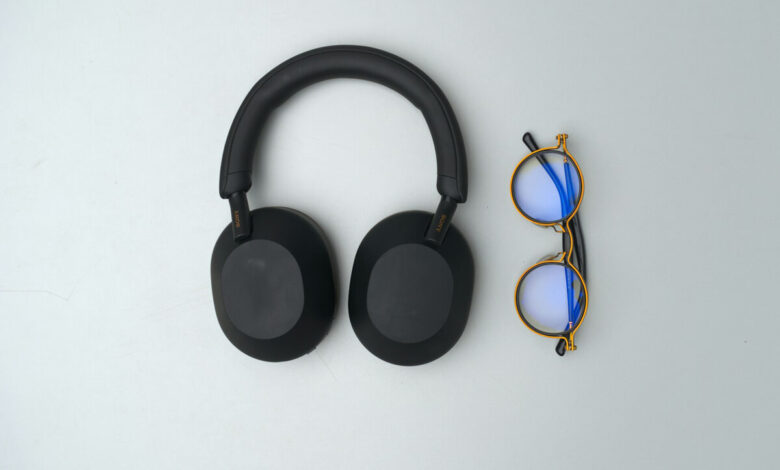
If your headphones sound thin and your temples ache the moment you put on glasses, the glasses arm is lifting the ear cup off your skin and breaking the acoustic seal. Here is the free test that confirms it in ten seconds: play a bass-heavy track, cup your hands over the ear cups, and press gently. If the bass suddenly arrives, the seal was the problem and it is worth fixing. If nothing changes, your glasses are not the cause, and the fix is somewhere else entirely.
Most articles on this topic pick one half of the problem and ignore the other. One camp explains the pressure and pain of glasses arms under a headband and stops there. The other explains the bass loss and the leaky seal and never mentions that your head hurts. They are the same problem, and treating them separately is why so many people cycle through tips that only fix one symptom at a time.
The hand-press test: confirm the seal is really your problem
Before changing anything, find out whether you actually have a seal problem. Put your headphones on the way you normally wear them, glasses and all, and start a track with real low end (a bass guitar or kick drum stands out more clearly than a full mix). Now press both ear cups gently inward with your palms, just enough to close any gap without hurting yourself.
Two outcomes, and both are useful:
- The bass fills in and the sound gets noticeably fuller. That confirms a broken seal. The glasses arm is holding the cup away from your head by a small but real gap, air is leaking out of the enclosed space between the pad and your ear, and that leak is what is taking the low frequencies with it. Everything in the rest of this article applies to you.
- Nothing changes when you press. The seal was already fine, or the loss you are hearing has a different cause (worn-out pads, a source EQ setting, a headphone that never had much bass to begin with). Do not spend time re-positioning glasses arms or shopping for new pads. Look elsewhere.
This test matters because it separates two very different problems that look identical from the inside: "my headphones sound worse since I started wearing these glasses" and "my headphones just do not have much bass." Only the first one is what this article fixes. Keep the test handy, because you will use it again after every fix below to check whether it actually worked, rather than guessing.
What a broken seal actually costs you
A sealed ear cup works like a small, closed chamber. Low frequencies need that chamber to stay closed to build pressure against your eardrum; that is a large part of how a closed-back headphone produces bass at all. A glasses arm crossing under the pad opens a gap in that seal, air escapes instead of building pressure, and the low end you would otherwise feel and hear thins out or disappears. The change is easiest to describe by what you notice, not a number: vocals and mids stay roughly where they were, but the mix loses its bottom and starts to sound thin, a little tinny, and closer to what you would hear from a small phone speaker than from the same headphones without glasses.
You will not just lose bass, either. Ambient room noise leaks in through the same gap, and if your headphones have active noise canceling, that leak works against it too: ANC is built to cancel a mostly-sealed environment, and a physical air gap gives outside sound a path in that the electronics were not designed to handle. If canceling has gotten weaker since you started wearing glasses with the same headphones, the seal is very likely why; our guide to ANC versus passive noise isolation covers how much each one depends on a physical seal in the first place.
None of this is a defect in your headphones. It is what happens whenever anything, glasses arms included, sits between the pad and your skin.
The one trade-off behind every fix: clamping force
Here is the piece almost nobody states directly: every fix for this problem moves along a single axis, and that axis is clamping force. More clamp presses the pad tighter around the glasses arm, restores the seal, and brings the bass back. Less clamp takes pressure off your temples and stops the ache, but it opens the same gap that costs you the seal.
You cannot get more of one without giving up some of the other. That is not a flaw in any specific headphone; it is physics. Recognizing it up front changes how you approach every fix below. You are not looking for a magic setting that solves both problems at once. You are choosing where on that line you want to sit, and then picking the specific change that gets you there with the least cost.
Keep that trade-off in mind through the rest of this list. Some fixes shift the line itself (better pad material can give you more seal at the same clamping force); others just move you along it.
Reposition first, it is free
Before you buy or change anything, try repositioning. The gap usually comes from the glasses arm crossing directly through the middle of the pad, right where the seal against your skin matters most. Two adjustments, both free and reversible:
- Move the glasses arm above or below the pad's contact channel. A small adjustment to how far your glasses sit on your nose, or a slight rotation of the headphone on your head, can shift the arm to a spot the pad does not need to seal against.
- Loosen the headphones' clamping force slightly, then compensate elsewhere. If your headphones have an adjustable headband or slider, a small reduction plus one of the pad-material or positioning changes below often nets out ahead of where you started.
This is the cheapest and most reversible step in the whole list, which is why it comes first. Run the hand-press test again after each small adjustment rather than after the whole list; that way you know exactly which change actually mattered, instead of stacking five changes and guessing which one worked. If a single reposition fully closes the gap, stop here.
Pad material: what conforms around an arm and what does not
If repositioning does not close the gap, the pad material itself is doing a lot of the work, or failing to. Based on published manufacturer material descriptions and the general acoustic principle of how each material behaves under sustained, uneven pressure (not first-party testing, since that is a claim this article does not make), the difference comes down to how each material responds to something poking into it from underneath:
- Memory foam is slow to spring back and conforms to the shape pressed into it, which is exactly what a thin glasses arm needs: the foam settles around the arm instead of bridging over it, keeping most of the pad in contact with your skin.
- Firmer materials, including protein leather and higher-density standard foam, hold their shape under the same pressure. That is an advantage for durability and a disadvantage here: the pad bridges over the glasses arm rather than molding around it, leaving a gap exactly where you need a seal.
If your current pads are the firmer type, a memory-foam replacement pad (widely sold for most mainstream headphone models) is a targeted fix that keeps everything else about the headphone the same. How much clamping force you need after the swap still depends on your specific headphone's headband design, so treat the pad change as one move on the same clamping-force axis from the section above, not a separate fix that replaces it. Re-run the hand-press test once the new pads are broken in, since foam softens slightly over its first few days of use.
One more option shows up constantly in this space and deserves a direct warning: cutting or carving a notch into your existing pads to make room for the glasses arm. It works, but it is irreversible and it will void most manufacturer warranties. Treat it as a last resort after repositioning, pad replacement and clamping adjustments have all failed, not a first move.
Why on-ear is the hardest case
If you wear on-ear headphones, the same problem is worse, and it is worth saying plainly: on-ear pads rest directly on the cartilage of your outer ear, which is the same cartilage your glasses arm already crosses on its way back to your ear. Over-ear headphones enclose the whole ear and only need to seal against the softer skin around it; on-ear headphones are pressing pad, ear cartilage and glasses arm into the same narrow strip of skin at once. That is why on-ear designs tend to hurt sooner and leak seal faster than over-ear designs at the same clamping force, and it is a genuinely buying-relevant fact if you are choosing between the two and you wear glasses daily. If you are deciding between sealed designs generally, our comparison of open-back versus closed-back headphones is a useful next read, since open-back designs do not rely on a tight seal at all and sidestep this problem in a different way.
When the answer is a different kind of headphone
If you have worked through repositioning, clamping adjustment and pad material and the hand-press test still shows a big jump in bass when you press, the honest answer is that over-ear or on-ear headphones and glasses may not be compatible in your specific combination, and it is time to consider a form factor that does not put a pad against a glasses arm at all.
In-ear headphones sidestep the seal problem entirely, since the tip forms its own seal inside your ear canal and never touches your glasses. They bring a different comfort trade-off of their own, covered in why earbuds hurt some ears, and if you are new to them, getting the fit right matters more than it does with over-ear pads; see how in-ear headphones are supposed to fit before assuming they will not work for you either. If in-ear tips are not comfortable for you either, bone-conduction headphones are worth knowing about as a category: they sit in front of the ear canal and send sound through the bones of your skull instead of a sealed cup or tip, so glasses arms never enter the equation at all. They trade away the bass depth of a sealed design, but that trade-off is a known, stable one rather than something that changes every time you put your glasses on.
For the full map of headphone and earbud comfort and sound problems, including this one, start at our headphone and earbud problem map.
Related reading
- ANC versus passive noise isolation
- Open-back versus closed-back headphones
- Why earbuds hurt some ears
- How in-ear headphones are supposed to fit
- Headphone and earbud problem map
FAQ
Do all headphones lose bass when worn with glasses?
No. Open-back headphones do not depend on a sealed chamber for their sound the way closed-back headphones do, so a glasses arm crossing the pad has much less effect on their bass. The hand-press test still works to check, but the effect will be smaller or absent, and on a genuinely open design it may be barely noticeable at all.
Will thinner glasses frames fix the problem on their own?
Often, partly. A thinner or wire-frame arm takes up less space under the pad, which can shrink the gap significantly. It is worth trying while listening, but it usually works best combined with repositioning or a softer pad rather than as the only fix, since even a thin arm still crosses the seal line somewhere.
Is cutting a notch in my ear pads a good fix?
Only as a last resort. It works, but it is irreversible and typically voids the headphone's warranty. Try repositioning, clamping adjustment and a pad-material swap first, and only consider it once you have confirmed with the hand-press test that nothing reversible closes the gap.
Does noise canceling still work if I wear glasses with headphones?
It will work less effectively if a glasses arm is breaking the seal, because ANC is designed around a mostly sealed ear cup and the same gap that lets bass escape also lets outside noise in past the electronics. Fixing the seal with the steps above typically restores most of the canceling performance along with the bass.
Are in-ear headphones the best option if nothing else fixes the seal?
For most glasses wearers, yes, since the seal happens inside the ear canal rather than against the glasses arm. They bring their own comfort trade-offs, so it is worth reading about proper in-ear fit before switching, and bone-conduction headphones are a reasonable next option if in-ear tips do not suit you either.


