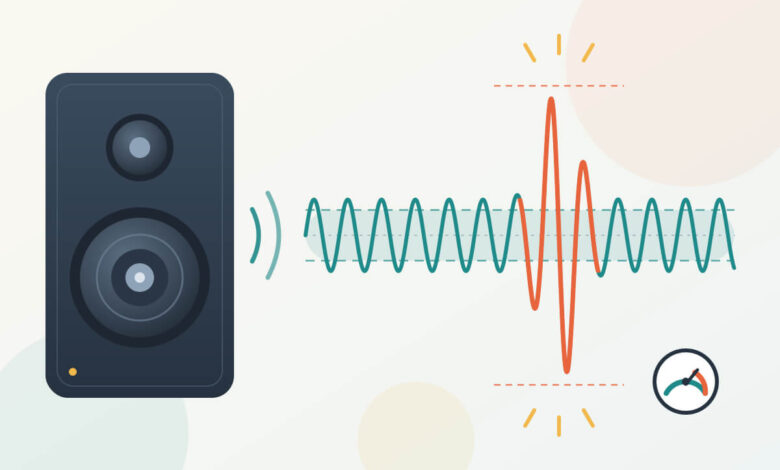
When you compare RMS vs peak power, speakers and amplifiers follow the same logic: the RMS figure describes continuous power, what the equipment can deliver or handle steadily over time. Peak power describes a brief maximum, a burst that lasts a moment, and it can be measured in ways that produce a much bigger number. That is why the largest wattage on the box is usually the peak figure. For comparing products and matching an amp to speakers, use the continuous rating, and only compare figures measured under the same conditions.
What RMS and peak actually mean
RMS stands for root mean square. Strictly, it is a way of averaging a signal that swings up and down, and “RMS watts” is shorthand for continuous average power. In everyday specifications, an RMS or continuous rating means the power an amplifier can keep delivering, or a speaker can keep accepting, without overheating or distorting beyond a stated limit.
Peak power is the highest level reached for a very short time. Music is full of brief peaks, such as a drum hit or a sudden orchestral swell, so peak capability is not meaningless. The problem is that a peak figure can be measured over a tiny fraction of a second, under conditions the manufacturer chooses, and it does not tell you what the equipment can sustain.
You will also see labels such as “max power,” “dynamic power,” “music power” and “PMPO” (peak music power output). These are all flavors of short-duration or best-case figures. Without the test conditions next to them, they cannot be compared with anything.
ELAC’s knowledge base article How to Match Amplifier & Speaker Impedance makes the same point from a speaker maker’s side: “Continuous Power (not peak or dynamic power) is the most reliable indicator of how well your amplifier can handle your speakers.”
RMS vs peak power speakers: the side-by-side
| Continuous (RMS) | Peak / max / PMPO | |
|---|---|---|
| What it describes | Power sustained over time | A brief maximum |
| Size on the box | Usually smaller | Usually the headline number |
| Useful for comparing products | Yes, if the test conditions match | Rarely |
| Useful for matching amp and speakers | Yes | No |
| What it should come with | Load in ohms, frequency range, distortion limit, channels driven | Often nothing |
The FTC rule behind US home audio power claims
In the United States, power claims for home audio amplifiers are governed by a federal rule, and knowing what it requires is the single best way to read a spec sheet.
The Federal Trade Commission’s Amplifier Rule, 16 CFR Part 432 covers “sound power amplification equipment manufactured or sold for home entertainment purposes,” a list that includes component audio amplifiers, self-powered speakers for computers, multimedia systems and sound systems.
Section 432.2 requires that whenever a manufacturer makes a claim about power output, the rated power output must be:
- measured under the standard test conditions set out in section 432.3,
- disclosed “clearly, conspicuously, and more prominently than any other representations or disclosures permitted under this part,”
- “clearly and conspicuously labeled ‘FTC Power Output Rating’,” and
- not hidden in “a footnote, asterisk, or similar notation.”
Section 432.4 then deals with every other power figure, including the peak-style numbers. Any other power output must be “clearly and conspicuously labeled ‘This rating was not tested under the FTC standard'” and must be less prominent than the FTC rating. The rule spells out that a figure “bold faced or more than two-thirds the height” of the FTC rating does not count as less prominent.
The test conditions in section 432.3 are demanding. Among other requirements, the amplifier is first preconditioned by “simultaneously operating all channels at one-eighth of rated power output for one hour,” and across the rated power band, which the section sets at 20 Hz to 20 kHz for standard amplifiers, any power level from 250 mW up to the rated power must be obtainable without exceeding 1.0% total harmonic distortion plus noise.
What this means for you: on a US home audio product, look for the words “FTC Power Output Rating.” That figure was measured under one shared method. A bigger number elsewhere on the box, labeled as not tested under the FTC standard, is the manufacturer’s own figure and cannot be compared like for like.
The rule’s scope is home entertainment. Car audio, professional audio and products sold outside the US fall outside it, so for those, the test conditions printed next to the number are all you have to go on.
How to read any power rating in five checks
When a box or listing gives a wattage, ask these questions before trusting it.
- Is it continuous or peak? If the label does not say, assume it is not a continuous figure.
- Into what load? A rating is measured into a specific impedance, such as 8 ohms or 4 ohms. The same amplifier produces a different figure into a different load. ELAC gives the example of an amplifier that “might deliver 100 watts at 8Ω and 150 watts at 4Ω,” an illustration of how specs are written rather than a figure for any particular product.
- Over what frequency range? A rating at a single frequency is easier to achieve than one held across the full 20 Hz to 20 kHz band.
- At what distortion? A figure measured at a higher distortion limit will be larger than one measured at a strict limit.
- With how many channels driven? A per-channel figure measured with one channel working can be higher than the figure with all channels working at once, which matters for multichannel receivers.
A rating that answers all five is informative. A rating that answers none of them is marketing.
Speaker power handling is a different number
Amplifier output and speaker power handling are often written in the same units, which causes confusion.
- An amplifier’s rating describes how much power it can deliver.
- A passive speaker’s power handling describes how much it can accept before overheating or mechanical damage. The FTC rule is written for amplification equipment, so a passive speaker’s handling figure is not something that rule measures.
When pairing them, compare continuous figures on both sides and check that the impedances match. Do not treat a speaker’s peak handling as permission to feed it that much power continuously.
One counterintuitive point: an amplifier pushed into audible distortion can harm speakers too, because a heavily clipped signal is harsher on the drivers than clean power. Playing within the clean range of both components matters more than which one has the bigger number.
Why the headline number is so often inflated
Peak figures are not always lies. They are simply answers to a different, easier question. A short burst is easier to deliver than a sustained output, a single frequency is easier than the full band, and a loose distortion limit is easier than a strict one. Stack those choices together and the headline can be far larger than the continuous figure.
Soundbars, portable Bluetooth speakers and computer speakers are where this shows up most, because the wattage is often a total across all the drivers inside. If you are choosing between those product types, our comparison of soundbars and bookshelf speakers covers the practical differences beyond the wattage.
Also note that not every watt on a product page is about sound. A portable speaker’s charger or USB-C input may list its own wattage, which describes charging power, not audio output. Our guide to USB-C Power Delivery ports explains what those charging figures mean.
What watts do not tell you about loudness
Even an honest continuous rating does not tell you how loud a system will be. Loudness also depends on speaker sensitivity (how efficiently a speaker turns power into sound), room size and listening distance. A more sensitive speaker can play as loud on less power. That is why two systems with the same wattage can sound very different, and why sensitivity belongs in any comparison alongside power.
Frequently asked questions
Should I look at RMS or peak power when buying speakers?
Look at the continuous (RMS) figure, along with the load in ohms and the conditions it was measured under. Peak figures are not measured consistently between brands and are not useful for comparing products or matching an amplifier.
What does “FTC Power Output Rating” mean?
It is the label US home audio amplifier makers must put on a power rating measured under the Federal Trade Commission’s standard test conditions in 16 CFR Part 432. It must be shown more prominently than any other power figure.
Is PMPO a real measurement?
PMPO stands for peak music power output. It is a short-duration, best-case figure with no shared test method, so it cannot be compared across products. Look for a continuous rating instead.
Can I use an amplifier with more watts than my speakers are rated for?
Often yes, if the impedances match and you keep the volume below the point where the speakers strain or distort. The speaker’s continuous rating, not its peak, is the figure to respect. Check both manuals for the maker’s own guidance.
Why does my amplifier list different watts at 4 ohms and 8 ohms?
Power output depends on the load. Many amplifiers deliver more power into a lower impedance, which is why ratings are always tied to a specific load. Only compare figures measured at the same impedance.